Indonesian Students Protest Toxic Wildfire Haze Over Palangkaraya
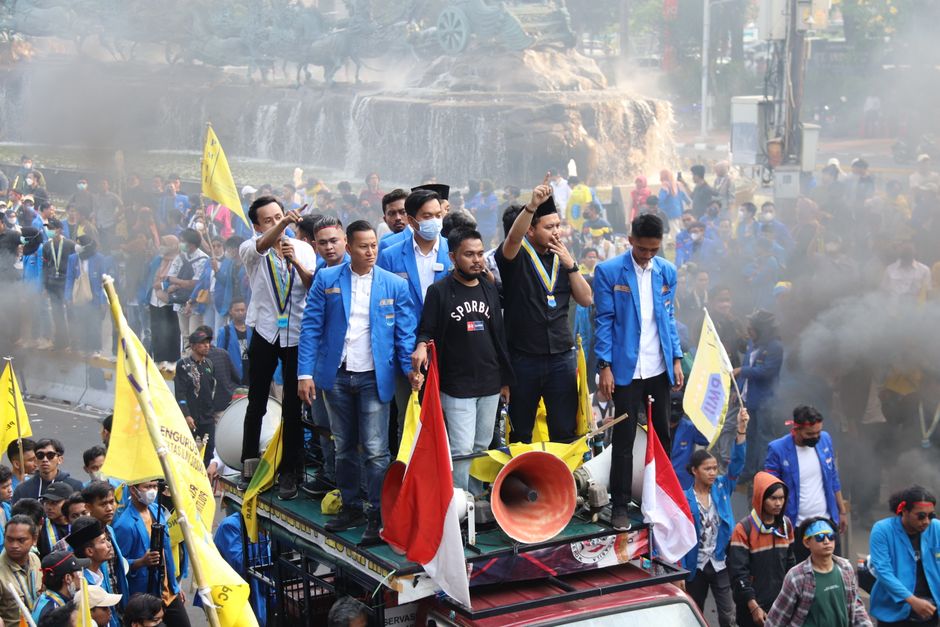
The demonstration signals growing public pressure on Jakarta to escalate its emergency response as the annual fire season again renders parts of Kalimantan nearly uninhabitable.
Hundreds of students gathered in Palangkaraya, the capital of Central Kalimantan province in Indonesia, late Friday to demand government action on a wildfire-driven haze crisis that has blanketed the city and surrounding region for months, according to Korea Times.
Protesters, many wearing surgical masks against the heavy smoke, assembled beneath an orange sky with severely reduced visibility, according to the Korea Times report. Banners called on authorities to declare a national emergency, a designation that would unlock additional government resources and aid for affected communities.
The haze originates primarily from peatland and forest fires on the island of Borneo, where Indonesian Kalimantan occupies the central and southern portions. Peatland fires are particularly difficult to extinguish because they can burn underground for extended periods even after surface flames are suppressed, according to Indonesia's National Disaster Management Agency, known by its Indonesian acronym BNPB.
Palangkaraya sits on one of the largest expanses of tropical peatland in the world. The city has repeatedly ranked among the worst-affected urban centers during Indonesia's annual dry-season fire cycle, which typically peaks between July and October when rainfall is scarce across Kalimantan and Sumatra.
The students' demand for a national emergency declaration is substantive in legal terms. Under Indonesian law, a national emergency designation grants the central government authority to mobilize military and civil resources beyond what provincial authorities can deploy independently, and to request international assistance through formal channels more efficiently.
Indonesia has faced recurring haze crises linked to land-clearing fires for decades. A particularly severe episode in 2015 burned more than 2.6 million hectares across the archipelago, according to data published by the World Resources Institute, and was associated with significant public health consequences across Indonesia, Malaysia, Singapore, and southern Thailand.
The haze routinely crosses international borders, creating diplomatic friction with Malaysia and Singapore, both of which have at various times recorded air quality readings classified as hazardous under their respective national standards. Singapore enacted the Transboundary Haze Pollution Act in 2014, which allows the city-state to prosecute companies operating in Indonesia whose burning activities cause haze in Singapore, though enforcement across sovereign borders remains limited in practice.
Indonesia's government has pledged repeatedly to reduce fire incidents through stricter land-use enforcement and the restoration of drained peatlands. A moratorium on new concessions in primary forests and peatlands, first issued by President Joko Widodo in 2018 and subsequently extended, was intended to reduce the economic incentive for fire-clearing. Whether that moratorium has been maintained and enforced under current policy remains a matter that BNPB and the Ministry of Environment and Forestry would need to clarify publicly.
The students' protest in Palangkaraya follows a pattern of civil society pressure that has intensified in Indonesian cities most directly exposed to smoke. What is not yet known from available reporting is whether the central government in Jakarta has formally responded to the protesters' demand for a national emergency declaration, or what specific new measures, if any, are under consideration as of October 24, 2026.
The health burden of sustained haze exposure is documented in peer-reviewed literature. Prolonged inhalation of fine particulate matter, designated PM2.5, is associated with respiratory and cardiovascular disease. The World Health Organization's air quality guidelines set a 24-hour mean PM2.5 limit of 15 micrograms per cubic meter. During severe haze episodes in Kalimantan, recorded concentrations have exceeded that threshold by multiples of ten or more, according to data compiled by IQAir, a Swiss air quality monitoring organization.
The Palangkaraya demonstration adds to visible domestic political pressure on Indonesia's government at a time when the administration of President Prabowo Subianto, who took office in October 2024, is still establishing its environmental governance posture. How Jakarta responds in the coming days will be a measurable indicator of whether national emergency tools will be deployed, or whether fire management will continue to be handled at the provincial level.