Oil Tanker Carrying 750,000 Barrels Hits Mine, Burns in Strait of Hormuz
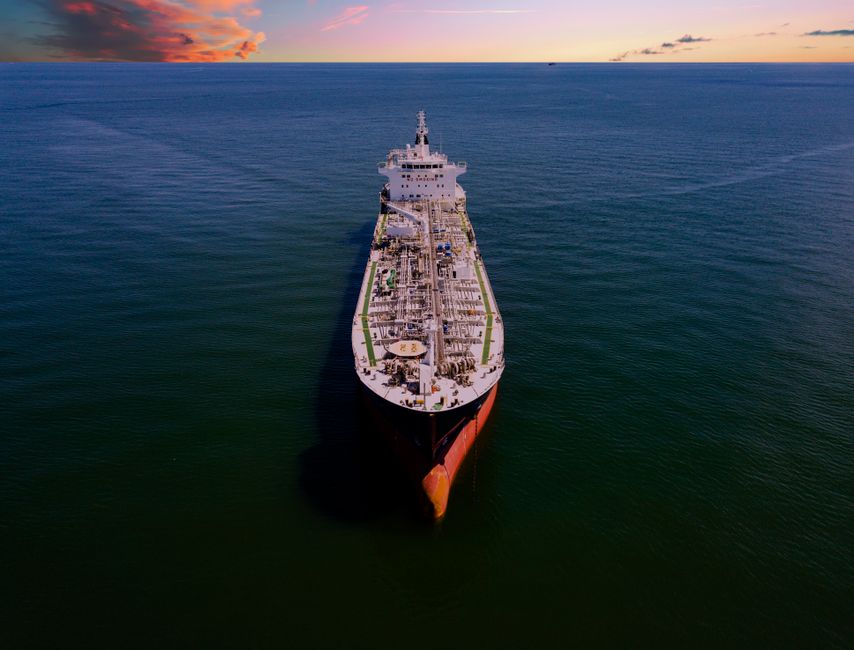
A naval mine detonation in one of the world's most critical oil shipping lanes raises the immediate question of whether the incident will affect global energy transit volumes and insurance costs...
A commercial oil tanker carrying 750,000 barrels of crude oil struck a naval mine and caught fire in the Strait of Hormuz on Sunday, according to a statement from Iran's Islamic Revolutionary Guard Corps (IRGC) as reported by Iran's state-affiliated Mehr news agency and covered by Al Bawaba.
The IRGC stated that the vessel attempted to cross what it described as an unauthorized route through the waterway despite prior warnings from Iranian forces. The ship then struck a naval mine and burst into flames. The identity of the tanker, its flag state, the operator, and the crew's condition had not been publicly confirmed in the reports available as of October 12, 2026.
The Strait of Hormuz is the world's most strategically significant oil chokepoint. According to the U.S. Energy Information Administration (EIA), approximately 20 to 21 million barrels of oil per day passed through the strait in recent years, representing roughly one-fifth of global petroleum liquids consumption. Any sustained disruption to transit through the strait carries direct consequences for global oil supply and pricing.
Naval mines in or near the Strait of Hormuz have precedent in the modern era. During the 1980s Tanker War, which formed part of the broader Iran-Iraq War, Iranian forces laid mines in the Persian Gulf that struck multiple commercial and naval vessels. In 1988, the USS Samuel B. Roberts, a U.S. Navy frigate, struck an Iranian mine in the Gulf, an event that escalated into Operation Praying Mantis, a U.S. Naval engagement against Iranian forces.
More recently, the strait and surrounding waters saw a series of tanker incidents in 2019, including mine-limpet attacks on vessels near the Gulf of Oman. The U.S. Government attributed those attacks to Iran at the time, a claim Iran denied. The incidents contributed to a temporary spike in war-risk insurance premiums for vessels transiting the region, according to reporting by Reuters in 2019.
The IRGC's public claim of responsibility for placing the mine, implicit in its statement that the vessel crossed an unauthorized route despite warnings, represents a notable assertion of authority over international shipping lanes. The Strait of Hormuz is recognized under international law as a strait used for international navigation, where vessels hold rights of transit passage under the United Nations Convention on the Law of the Sea (UNCLOS), to which Iran is not a party, though Iran is bound by customary international law provisions relating to navigation.
Neither the United Nations nor any government had issued a formal public response to the incident as of the time of this report. The International Maritime Organization (IMO), which maintains the GISIS database of maritime security incidents, would be the principal multilateral body expected to log and assess the event. Whether the flag state of the tanker has lodged a protest or requested consultation was not publicly available in the source material reviewed.
The timing of the incident coincides with an already elevated regional tension environment. Separately, Iran's Supreme National Security Council has publicly signaled, through statements attributed to Major General Mohsen Rezaei and reported by Press TV on October 12, 2026, that Iran would consider targeting U.S. Technology infrastructure in the region if Iran itself were attacked. The relationship between those statements and the mine incident is not established by the available source material.
For commercial shipping operators, the immediate practical consequence of a confirmed mine strike in active transit lanes is typically a reassessment of routing and the invocation of war-risk insurance clauses. Lloyd's of London's Joint War Committee maintains a list of high-risk areas; whether it will update that list to reflect the current incident was not available at time of publication.
What remains unknown includes the name and nationality of the tanker, the status of its crew, the extent of the fire and any oil spill, and whether any government has formally protested the mine's presence to Iran through diplomatic or international legal channels. Public statements from the tanker's operator or the flag state government would be the most direct sources to clarify those facts.